
Did you know that each day the average household dumps 270 gallons of waste water into the sewer system through washing dishes, taking showers, flushing the toilet, shaving, using the washing machine, etc.
Did you ever wonder where this water goes?
Duckett Creek Sanitary District uses two forms of treatment technology to clean the wastewater. The first is a traditional wastewater treatment plant. The second technology is called Membrane Bioreactor or MBR. The MBR technology discharges water 10 times cleaner than traditional treatment methods.
Traditional Method
Step One
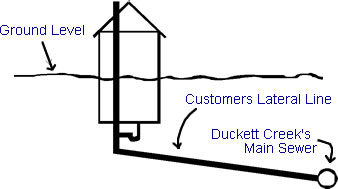
Each drain in the house empties into a “lateral line” that leads from the house to a main sewer line owned by Duckett Creek. In most cases, the lateral line runs on an angle so that GRAVITY does all the work.The homeowner owns the lateral line and is responsible for it’s maintenance. The main cause of sewer backups is tree roots entering and clogging the lateral line.
Step Two
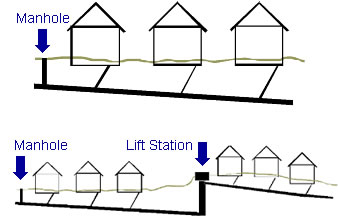
The miles and miles of main sewer lines empty into collector lines. This flow is also done accomplished by gravity. Manholes are constructed approximately every thousand feet to allow for maintenance on the lines. When the line becomes too deep, lift stations pump the water to a higher elevation so that gravity can again do it’s job. Duckett Creek has lift stations in its system.
Step Three
Through miles and miles of gravity lines and with the help of various lift stations and two main pump stations, the waste water reaches one of the treatment plants.
Step Four
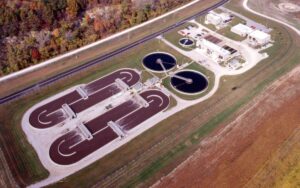
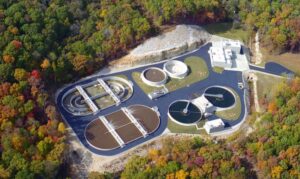
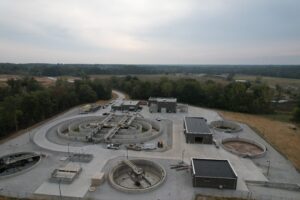
At the treatment plant the process of “cleaning” the wastewater and returning it to nature begins. The process begins at the handling building where debris like wood and other large objects that have infiltrated the system are removed.
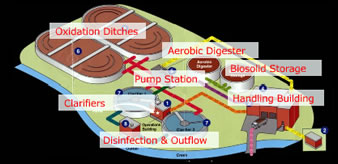
The pump station pumps the waste water to the oxidation ditches. This is a key element of the plant. Micro organisms are allowed to digest the solids in the waste.
After approximately 24 hours the water is transferred to the clarifiers. The micro organisms, being heavier than water, are allowed to sink to the bottom.
The clean waster rises to the top and is sent to disinfections. It passes through a series of ultra-violet lights which deactivate any remaining microbes.
Step Five
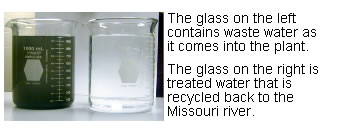
After being disinfected the water is released into a stream adjacent to the plant. The stream carries the treated water to the Missouri river.
The solid material that sinks to the bottom of the tanks is called sludge. The sludge is removed and sent to storage tanks where it dries. It is then sent through a press which removes any remaining water. What remains is “fertilizer”. Duckett Creek works with local farmers to spread this fertilizer on local farm lands.

The treatment process at Duckett Creek is completely natural with NO chemicals involved and all by-products are recycled back to nature.
MBR Technology Method
Step One
Each drain in the house empties into a “lateral line” that leads from the house to a main sewer line owned by Duckett Creek. In most cases, the lateral line runs on an angle so that GRAVITY does all the work.The homeowner owns the lateral line and is responsible for it’s maintenance. The main cause of sewer backups is tree roots entering and clogging the lateral line.
Step Two
The miles and miles of main sewer lines empty into collector lines. This flow is also done accomplished by gravity. Manholes are constructed approximately every thousand feet to allow for maintenance on the lines. When the line becomes too deep, lift stations pump the water to a higher elevation so that gravity can again do it’s job. Duckett Creek has lift stations in its system.
Step Three
Through miles and miles of gravity lines and with the help of various lift stations and two main pump stations, the waste water reaches the membrane bioreactor plant.

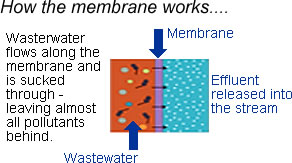
Membrane BioReactor (MBR) Technology is an innovative type of wastewater treatment. Instead of using gravity and a settling tank to separate the clean water from the waste, the wastewater is forced through the membrane which is able to filter out virtually all sediment and solids plus removes viruses and bacteria. A traditional wastewater treatment plant discharges water that meets secondary treatment standards. An MBR plant discharges water that is approximately ten times cleaner.
Step Four
MBR water does not need any additional disinfected before being released into the adjacent stream. The stream carries the effluent (treated waste water) to the Missouri river.
The solid material that sinks to the bottom of the tanks is called sludge. The sludge is removed and sent to storage tanks where it dries. It is then sent through a press which removes any remaining water. What remains is “fertilizer”. Duckett Creek works with local farmers to spread this fertilizer on local farm lands.
The treatment process at Duckett Creek is completely natural with NO chemicals involved and all by-products are recycled back to nature.